

Data decay is one of the most overlooked problems in marketing, even though it affects nearly every campaign. It refers to how marketing data slowly becomes less accurate over time as people move, change circumstances, or update personal information. Most marketers do not actively think about it because the data often looks “good enough” on the surface.
The issue is that even small amounts of data decay can reduce direct mail data performance, lower targeting accuracy, and increase wasted spend. A campaign can have strong creative and offers, but still underperform if it is built on outdated records.
This is why data accuracy and freshness matter. KYC Data updates homeowner records daily, with over 45,000 new homeowner records added weekly from verified property deed records.
Get a Free Data Sample and see the difference fresh, daily updated data can make in reducing the impact of data decay.
What Is Data Decay?
Data decay is the gradual loss of accuracy in a marketing database over time. It happens when information about people, households, or businesses becomes outdated or incorrect.
In simple terms, data decay means:
● Records stop reflecting reality
● Contact details become inaccurate
● Targeting becomes less precise
Marketing databases are not static. They constantly age because people’s lives change. A homeowner listed in a marketing database today may not have the same address, mortgage status, or intent a few months later.
This is why data hygiene and regular updates are necessary to maintain usable customer acquisition data. Without updates, even well-built lists become less effective.

Why Marketing Data Starts Aging Immediately
Marketing data begins to age the moment it is collected. This is one of the most important but least acknowledged facts in acquisition marketing.
There are several reasons this happens:
People Move
● Homeowners change addresses regularly
● Rental situations shift frequently
● Geographic targeting becomes outdated
Homes Are Sold
● Ownership changes affect relevance
● New buyers replace previous occupants
● Old records lose value quickly
Mortgages Change
● Refinancing alters financial profiles
● New loans change targeting signals
Consumer Needs Change
● Intent fades over time
● Purchasing windows are short
● Relevance decreases quickly
According to general housing market trends, a significant portion of homeowners move or refinance within a few years, which means even moderately aged lists can quickly lose accuracy.
The longer records sit unused in homeowner mailing lists, the more they suffer from data decay and reduced marketing performance.
How Data Decay Impacts Direct Mail Campaigns
In direct mail performance, data decay directly affects how efficiently campaigns reach the right audience.
Key impacts include:
Lower Relevance
Outdated records often mean messaging reaches people who no longer fit the target profile.
Missed Opportunities
Campaigns arrive after the buying window has passed.
Poor Audience Timing
Even accurate offers fail when timing is wrong.
Increased Waste
Mail is sent to contacts who are no longer valid or relevant.
A campaign can still have strong creative and offer quality, but if the underlying direct mail data is outdated, performance drops because the message reaches the wrong people at the wrong time.
Why Most Marketers Ignore Data Decay
Most marketers do not actively track data decay, even though it affects results. Common reasons include:
● Focus on creative instead of data quality
● Emphasis on audience size over accuracy
● Assumption that data remains stable
● Lack of visibility into data aging
● Campaign issues blamed on execution instead of inputs
The key problem is that data quality issues are often invisible. When performance drops, marketers usually adjust messaging or targeting strategy rather than questioning whether the underlying data has aged.
The Hidden Cost of Outdated Data
Outdated data affects every part of a campaign budget, even without obvious warning signs. Costs include:
● Printing expenses for unnecessary mail
● Postage costs on low-quality contacts
● Design and production costs
● Labor spent managing poor lists
● Lost acquisition opportunities
Even if individual costs seem small, they compound across large campaigns. This is why mailing list accuracy is a critical factor in overall efficiency.
The real issue is not just wasted spend, but missed opportunities to reach high-intent homeowners during active decision-making periods.
Why Data Freshness Matters More Than Most Marketers Realize
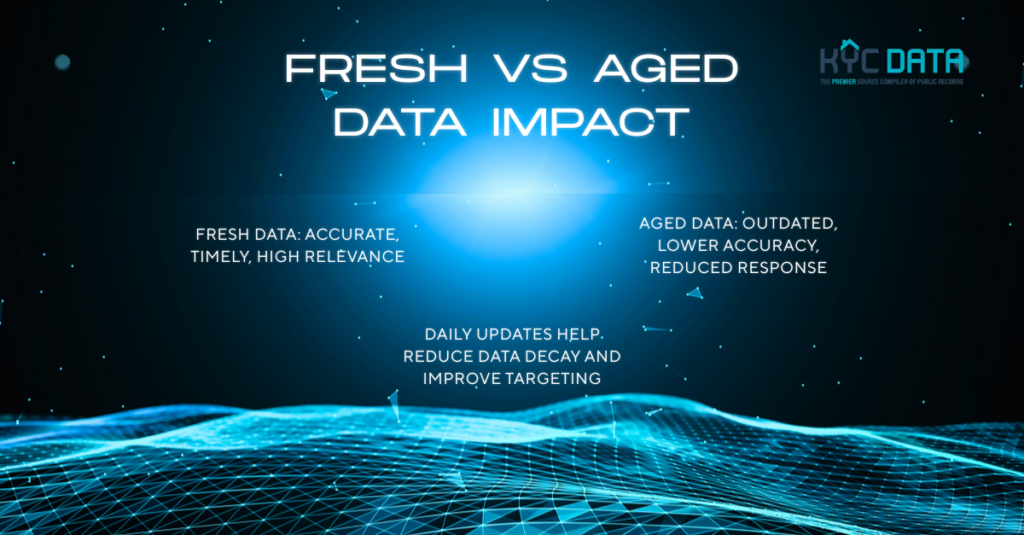
Fresh data is not just a quality improvement—it is a timing advantage.
Here is the difference:
Fresh homeowner records
● Higher relevance
● Better alignment with intent
● More accurate targeting windows
Older homeowner records
● Reduced relevance
● Missed timing opportunities
● Lower engagement likelihood
This is especially important in direct mail targeting, where timing directly influences whether a homeowner is actively considering a purchase or has already made a decision.
Freshness determines whether a campaign reaches a prospect during a meaningful window or after interest has faded.
How Daily Updated New Homeowner Data Reduces Data Decay
One of the most effective ways to reduce data decay is through frequent updates.
KYC Data addresses this by providing:
● Daily updates to homeowner records
● Over 45,000 new homeowner records added weekly
● Verified property deed data for accuracy
This continuous update cycle ensures that fresh homeowner records stay closely aligned with real-world property changes.
It also reduces the lag between a home purchase and marketing outreach, improving timing for new homeowner data campaigns.
Faster access to updated records allows marketers to act while intent is still high.
Request a Free Data Sample to access daily updated homeowner records and reduce the impact of data decay.
Signs Your Marketing Database May Be Suffering From Data Decay
Common warning signs include:
● Declining response rates
● Increasing number of outdated contacts
● Lower engagement across campaigns
● Inconsistent performance over time
● Reduced campaign efficiency
These signals often indicate that the marketing database is aging faster than it is being updated.
How to Build a Data Hygiene Strategy
A strong data hygiene strategy helps reduce the impact of data decay over time. Key steps include:
● Reviewing all data sources regularly
● Prioritizing fresh and verified records
● Updating data on a consistent schedule
● Focusing on high-intent segments
● Measuring performance changes over time
Good data hygiene ensures that direct mail data remains usable and aligned with real-world conditions.
Why Fresh Data Creates a Competitive Advantage
Fresh data does more than improve accuracy—it improves timing.
Benefits include:
● Faster access to new buyers
● More relevant targeting
● Reduced waste in campaigns
● Better alignment with intent windows
In competitive markets, the first marketer to reach a homeowner often has a higher chance of engagement. This is why freshness is a strategic advantage, not just a technical detail.
Conclusion
Data Decay is unavoidable in any marketing database, but it is often ignored until campaign performance declines. As records age, data accuracy drops, reducing the effectiveness of even well-planned campaigns.
The solution is not just better targeting or creative—it is fresher data and stronger data hygiene practices.
With daily updates and over 45,000 new homeowner records added weekly, marketers can reduce the impact of data decay and improve timing, relevance, and overall direct mail performance.
Get a Free Data Sample and see how daily updated homeowner data can help reduce the impact of data decay on your campaigns.