A new homeowner mailer can acknowledge a home purchase, but it usually does not need to repeat the sale price, seller name, or exact closing details. A stronger approach is to lead with a useful offer and identify your business clearly. Treat the purchase as audience context, not proof that someone has moved in or needs your service. This is the central point behind new homeowner direct mail personalization. The record can help a marketer decide who should receive a piece, while the copy should focus on a relevant reason to respond. For marketers, that distinction can make personalized homeowner mailers more useful and less intrusive. Ask whether each detail helps the recipient understand the offer, or is included only because the data makes it possible.
Does a mailer need to mention the purchase?
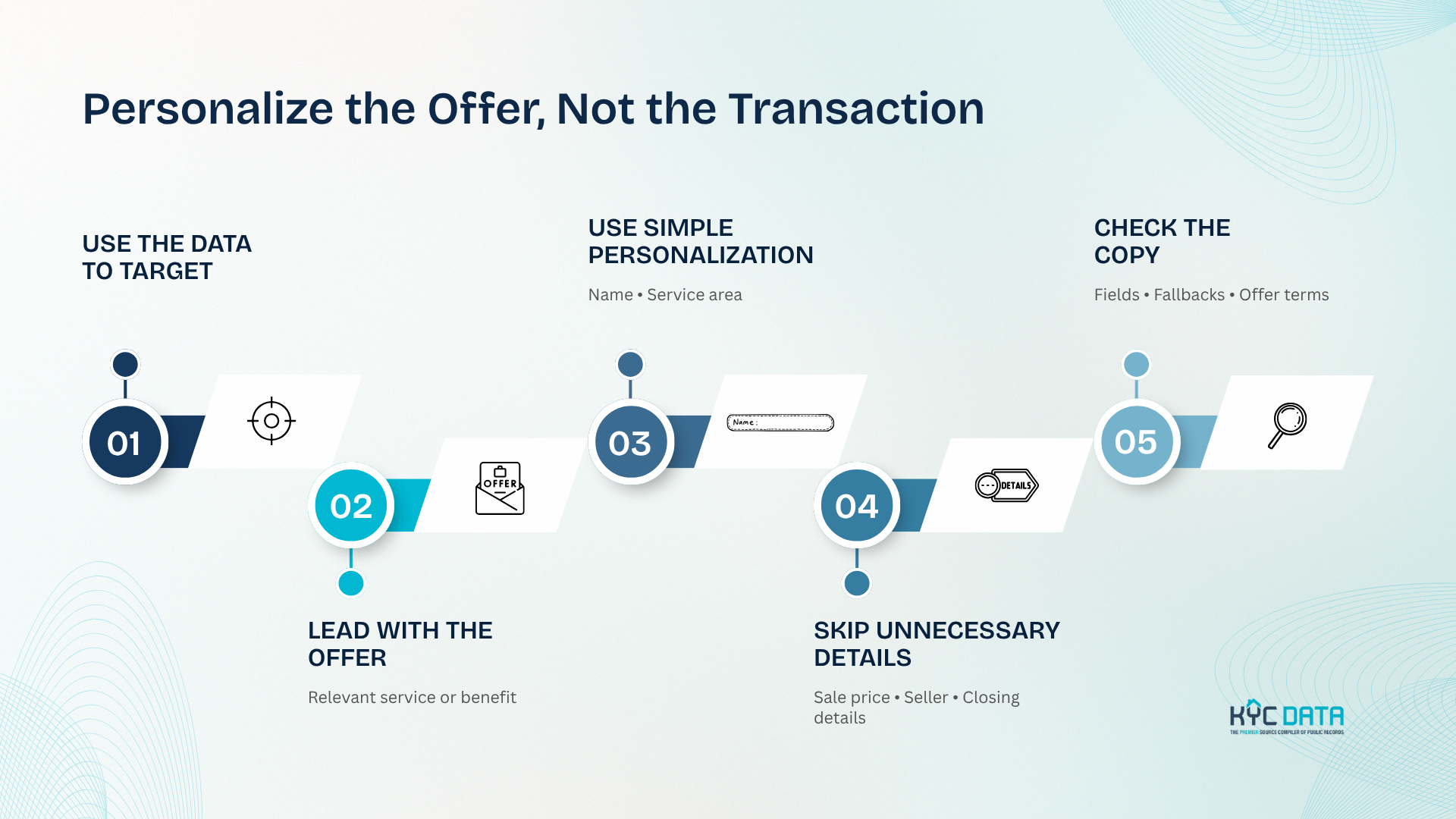
No. A mailer can be relevant without saying that the recipient recently bought a home. The purchase record can guide audience selection and offer planning without becoming a headline.
A landscaping company can use new homeowner data to reach people in its service area, then lead with lawn care or seasonal maintenance. The relevance comes from the service and audience.
This approach keeps new homeowner marketing focused on a useful reason to consider the advertiser. It also avoids treating a recorded transaction as proof that the recipient has moved in, needs a particular service, or intends to buy it. Property purchase data is context. The offer is the message.
Which details belong in the message?
| Detail | Use in copy? | Editorial approach |
|---|---|---|
| Name or service area | Usually | Use only when accurate and appropriate. |
| General home-related offer | Yes | Lead with a clear benefit or service. |
| Sale price, seller name, closing details | Normally no | Keep transaction details as audience data unless there is a specific reason to disclose them. |
A marketer does not need to print every field in a homeowner mailing list. KYC Data’s new homeowner data includes fields such as buyer name, address, seller name, sale price, dwelling type, and Delivery Point Barcode. Those fields can support audience selection, but their availability does not mean they belong in direct mail copy. The strongest direct mail copy makes the service, offer, and next step easy to understand.
What does respectful personalization look like?
Respectful personalization starts with the benefit, then uses personal details only when they help the reader understand the message.
Before: “We saw what you paid for your new home.”
After: “New homeowners can save on their first seasonal lawn service. Ask about availability in your area.”
The second version uses purchase context without exposing a transaction amount.
Before: “You just moved into your new home.”
After: “If you are settling into a new home, our team can help with your first lawn service.”
The conditional wording matters because property purchase data does not establish an exact move-in date or owner occupancy. Good personalized homeowner mailers should use what the data supports and avoid presenting assumptions as facts.
How can the sender and offer stay clear?
Every mailpiece should make the advertiser identifiable. State the business name, relevant service area, offer terms, and next step clearly. If the offer has eligibility rules or an expiration date, state them accurately.
Avoid copy that resembles an official notice, creates false urgency, or suggests that the advertiser is a lender, government agency, or other organization when it is not.
A reference for broader direct mail best practices is KYC Data’s existing guidance on audience selection, timing, personalization, and message clarity. The article is broader than this copy-focused question, while this article concentrates on what should actually appear on the mailpiece.
Relevant mailing offers should make the commercial purpose obvious. Personalization should support clarity.
What should you check before printing?
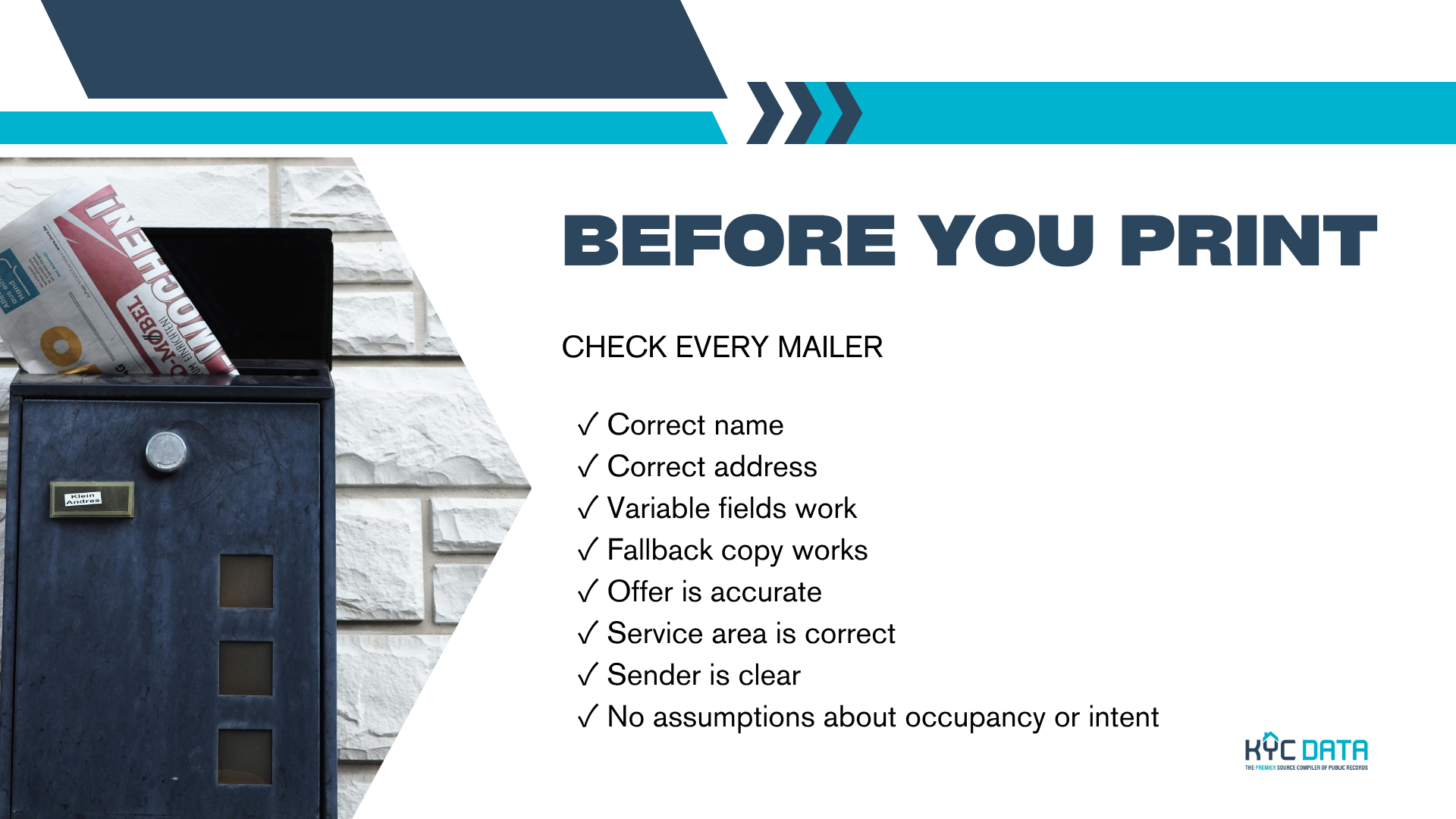
Review the printed copy, not just the template. Check names, addresses, variable fields, punctuation, offer eligibility, service areas, and fallback text for records where a field is missing.
Also separate mailing accuracy from assumptions about the household. A correct property address does not prove who occupies the home, when someone moved in, what services they need, or whether they intend to buy.
This is where data hygiene supports the copy process. Clean fields reduce avoidable merge errors, but marketers still need a human review of the finished piece.
Before printing, review a proof. Confirm that every variable field has a sensible fallback. The advertiser should handle requests from recipients who want future mailings removed.
How should you test personalized copy?
Test restrained copy variations within one eligible audience. Keep the offer, timing, format, and audience criteria consistent when comparing versions so that the message itself is the main difference.
One version might use the recipient’s name and a general new-home offer. Another might use the same offer without purchase-related wording. A third could use conditional language about settling into a home.
Track qualified inquiries alongside complaints and removal requests. USPS guidance describes methods for tracking direct mail responses, but campaign results still depend on the specific audience, offer, creative, and measurement setup. A test can show how an audience responds to particular copy. It does not establish that personalization always increases response.
Testing can also show which variable fields are worth keeping. If a detail does not improve clarity, there may be little reason to print it.
Conclusion
The best new homeowner direct mail personalization does not mean putting every available property detail on a postcard. Use purchase data to select a relevant audience, then give the recipient a clear offer from an identifiable business.
Before printing, check every variable field, fallback message, address, and offer term. Remember that a purchase record does not establish occupancy, needs, or intent. If you are evaluating a homeowner mailing list, request a free KYC Data sample and inspect the available fields before writing your variable copy. KYC’s free-data form states that its consumer marketing data does not include phone numbers or email addresses. That makes it easier to plan a mailpiece around the fields the dataset actually provides.