
In direct mail marketing, timing matters more than many marketers realize. Most teams focus on audience targeting, creative, or offer structure, but often overlook one of the biggest performance variables: data delivery speed direct mail.
The timing of your data affects when your campaign reaches the mailbox. If your records arrive too late, your audience may already have made a decision, chosen a competitor, or moved past the highest-intent stage.
This is especially important in time-sensitive campaigns tied to new homeowners, movers, insurance purchases, or home service decisions. In these markets, speed creates opportunity.
This article explains how slow data impacts campaign performance, why faster delivery creates a competitive advantage, and how marketers can improve timing before launching their next campaign.
Why Timing Matters in Direct Mail Campaigns
Direct mail performance is closely tied to timing.
Certain audiences are highly responsive during short decision windows:
● New homeowners
● Recent movers
● Homeowners starting major projects
● Consumers making insurance or financing decisions
These moments create temporary buying intent.
For example, new homeowner data timing is critical because many purchasing decisions happen within the first 30 to 90 days after moving:
● Insurance selection
● Internet setup
● Landscaping services
● Security systems
● Solar consultations
● Roofing and remodeling quotes
Once those decisions are made, response likelihood often declines.
This is why campaign timing direct mail strategies matter. Reaching a household early increases relevance and reduces competition.
The First-to-Mail Advantage
The first company to reach the mailbox often gains a measurable advantage. This is known as the first-to-mail effect:
● The first brand seen establishes awareness
● Early offers shape pricing expectations
● Early outreach reduces competitive clutter
In practical terms, the first mail piece may receive more attention simply because the homeowner has not yet been overwhelmed with competing offers.
Example:
A solar company reaching a homeowner within the first few weeks after move-in may schedule consultations before competitors begin outreach
The same pattern appears in:
● Insurance campaigns
● Home security campaigns
● HVAC and roofing campaigns
● New mover marketing
Timing alone does not guarantee results. But earlier outreach creates stronger conditions for engagement.
What Happens When Your Data Is Delayed
Slow data changes campaign performance in several ways.
Lower Response Rates
When outreach arrives late, intent may already be fading. Response rates generally decline as the time between the triggering event and the mail drop increases.
For example:
Direct mail response rates commonly range between 2% and 5% depending on audience quality and timing
Older records often perform below those benchmarks because relevance decreases over time Increased Competition
Late campaigns enter a crowded environment.
If competitors already contacted the household:
● Brand awareness has already been established
● Initial purchasing decisions may already be made
● New offers face more resistance
This raises acquisition difficulty.
Reduced Visibility
Consumers pay more attention during active transition periods. Once routines are established, marketing becomes easier to ignore.
Late outreach often competes against:
● Existing service contracts
● Existing vendor relationships
● Reduced urgency
● Higher Cost Per Acquisition
When timing weakens response rates, costs rise:
● More mail volume is needed
● More touches are required
● Conversion efficiency declines
This increases cost per acquisition and reduces campaign efficiency.
How Slow Data Impacts Campaign Performance
The impact of slow data is measurable across several areas.
Conversion Rates
Fresh records align more closely with active decision-making periods. Older records reduce alignment between timing and intent.
Comparison:
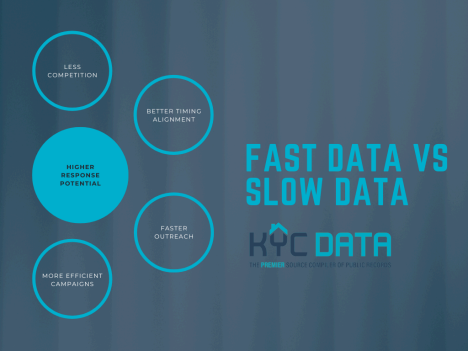
● Faster Data vs Slower Data
● Earlier engagement vs Delayed engagement
● Stronger timing alignment vs Reduced relevance
● Less competition vs More competition
● Better campaign efficiency vs Higher acquisition costs
Campaign ROI
Timing affects return on investment because wasted outreach increases costs without improving conversions.
A delayed list may still contain technically accurate records, but performance can decline simply because the opportunity window has narrowed.
Campaign Efficiency
Slow delivery creates operational inefficiencies:
● Delayed launches
● Missed seasonal windows
● Longer optimization cycles
In high-volume campaigns, even small delays compound quickly.
Why Many Data Providers Fall Behind
Not all providers update and process records at the same speed.
Common industry problems include:
Batch Updates
Some providers update records weekly or monthly instead of daily. This creates lag between the triggering event and list availability.
Outdated Sources
Older databases may still circulate through the market long after the original records were collected.
This creates “aged data” problems:
● Reduced intent
● Lower relevance
● Delayed outreach
● Slow Processing
Some providers rely on slower manual workflows for:
● Data aggregation
● Verification
● Formatting
This extends turnaround time.
Resold Lists
Bulk or recycled lists may prioritize volume over freshness. These lists often lack the timing advantage needed for performance-driven campaigns.
How Faster Data Creates a Competitive Advantage
Faster data improves positioning in several ways.
Better Timing
Fresh records allow campaigns to launch closer to key life events.
For example:
A home services company reaching a homeowner during the move-in phase is more likely to align with active purchasing decisions
Higher Response Potential
Earlier outreach improves the chance that the message is seen before competitors saturate the mailbox.
More Conversions
When timing aligns with intent, campaigns operate more efficiently:
● Less wasted mail
● Stronger engagement
● Better use of budget
This is why fresh data marketing strategies increasingly prioritize speed alongside accuracy.
Why Marketers Choose KYC Data
KYC Data is built for performance-focused direct mail campaigns where timing matters. Key advantages include:
● Daily new homeowner and mortgage data
● Records support time-sensitive outreach
● Fast delivery for time-sensitive campaigns
● Designed to reduce delays between data acquisition and campaign launch ● Verified records ready for immediate use
● Records are processed and structured for campaign deployment
● Pre-scrubbed data to reduce waste
● Duplicate suppression and list hygiene help improve usability
● Built for performance-focused marketers
● Structured around campaign timing, targeting, and operational efficiency The goal is simple: help marketers reduce delay and improve timing alignment.
How to Know If Your Data Is Too Slow
Many marketers do not realize their data is arriving too late.
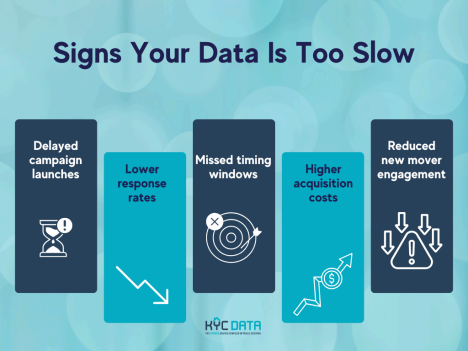
Common warning signs include:
● Lower-than-expected direct mail response rates
● Delayed campaign launches
● Slow turnaround from providers
● Difficulty aligning campaigns with new mover activity
● Reduced engagement in time-sensitive offers
If performance improves when campaigns launch earlier, timing may already be affecting results.
How to Improve Your Campaign Timing
Improving timing usually starts with the data process itself.
Practical steps include:
● Use fresher data sources
● Reduce internal approval delays
● Align creative production with data release schedules
● Prioritize providers with faster turnaround times
● Review update frequency before purchasing lists
Small improvements in timing can compound across:
● Multiple campaigns
● Multiple markets
● Multiple client accounts
● Common Misconceptions About Timing
Several assumptions continue to limit campaign performance:
● “Timing doesn’t matter as much as targeting”
● “All data providers deliver at the same speed”
● “Late is better than never”
● “Volume matters more than timing”
In practice, timing and freshness strongly influence how effective targeting becomes.
Conclusion
In direct mail marketing, timing is a competitive advantage. The faster you reach a prospect after a key event, the more likely your campaign is to align with active intent.
When your data delivery speed direct mail process is slower than your competition, opportunities narrow quickly. Response rates decline, acquisition costs rise, and competitors gain the first-touch advantage.
Fresh, fast, verified data supports stronger campaign timing and more efficient outreach. For marketers running time-sensitive campaigns, speed is not just an operational detail. It directly affects performance.
Contact KYC Data Today
If timing matters to your campaigns, request fresh data, get a sample list, or talk to KYC Data about improving campaign timing and delivery speed.