
Multi-touch direct mail campaigns generally outperform one-time mailings because they create repeated brand exposure, improve familiarity, and reach homeowners at different stages of their decision-making process. Instead of relying on a single postcard to generate action, businesses build multiple marketing touchpoints that stay visible over time.
A common scenario in direct mail marketing looks like this: a company invests in a well-designed postcard, mails it to a high-value homeowner list, and waits for responses. When results are limited, the campaign is often considered unsuccessful. The issue is rarely the creative itself—it’s the expectation that one interaction should drive immediate conversion. Most homeowners don’t act after a single exposure. They respond after repeated reminders aligned with timing, need, and trust-building.
That’s where a structured multi-touch direct mail strategy becomes more effective.
What Is a Multi-Touch Direct Mail Campaign?
A multi-touch direct mail campaign is a planned sequence of mail pieces delivered over time to the same audience. Instead of sending one message, businesses send a coordinated series of communications designed to reinforce a consistent offer or value proposition.
This approach is not simply “sending more mail.” It is a structured direct mail sequence where each piece plays a role—introducing, reinforcing, educating, and prompting action. Messaging, timing, and creative elements are aligned so each touchpoint builds familiarity and recognition.
In effective multi-touch marketing, the goal is repetition with purpose. Each mailing strengthens the previous one rather than repeating it.
Why One-Time Mailings Often Fall Short
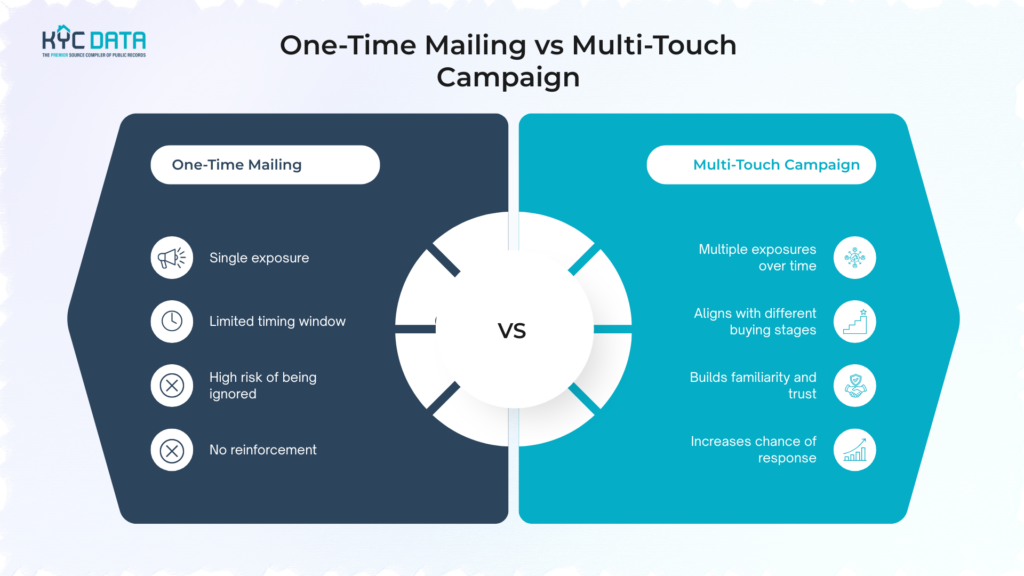
One-time mailings often underperform because they assume the timing of the message will perfectly match the homeowner’s need. In reality, that alignment is rare.
Homeowners are busy, distracted, and exposed to multiple marketing channels every day. Even if a postcard is relevant, it may arrive before a need exists—or after a decision has already been made. Some prospects will notice it but delay action, while others may never register it at all.
A single mailing creates only one opportunity for engagement. If that moment is missed, the campaign effectively ends. Multi-touch campaigns extend that opportunity across multiple exposures, increasing the likelihood that at least one touchpoint aligns with intent.
Marketing Is About Being Remembered
Effective direct mail marketing is less about immediate response and more about sustained visibility. Homeowners rarely choose the first business they see—they choose the one they recognize when the need becomes urgent.
Repeated marketing touchpoints build familiarity over time. When messaging stays consistent across multiple mailings, businesses become easier to recall. This familiarity plays a key role in how homeowners evaluate options later in their decision process.
Rather than relying on persuasion in a single moment, multi-touch marketing focuses on staying present throughout the consideration cycle.
Homeowners Don’t All Buy at the Same Time
Different services have very different buying timelines, which is why timing plays such a critical role in campaign effectiveness.
For example:
● Roofing services may be needed immediately after damage or inspection ● HVAC replacements often follow system failure
● Landscaping services are considered after moving into a new home
● Insurance decisions often happen right after closing
● Solar installations may take months of consideration
● Window treatments and remodeling projects can span 6–18 months
A single mailing cannot realistically align with all these timelines. Multi-touch direct mail campaigns allow businesses to remain visible across extended and unpredictable buying windows.
Why Fresh Homeowner Data Is Critical
Campaign performance is not only about messaging—it is also about data quality. Fresh, verified homeowner data ensures mail reaches people at the right stage of their homeownership journey.
Outdated lists lead to wasted spend, inaccurate targeting, and missed opportunities. Fresh data improves timing by ensuring businesses are contacting homeowners when marketing opportunities are still relevant.
Platforms like KYC Data support this process through verified homeowner records, daily updates, and data hygiene practices. This helps marketers reduce waste and build campaigns on a more reliable foundation, especially when running ongoing multi-touch sequences.
Building an Effective Direct Mail Sequence
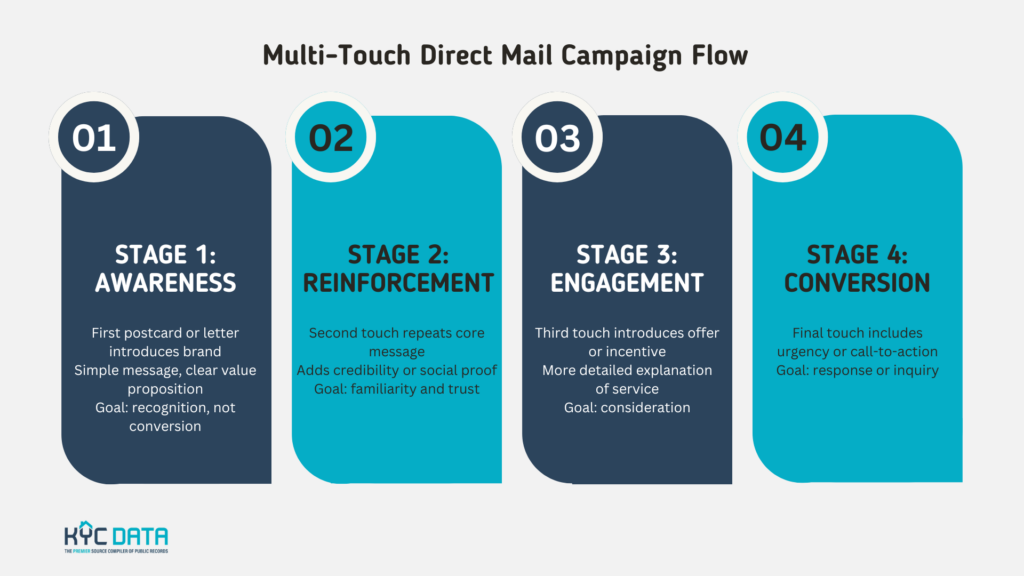
A strong multi-touch direct mail campaign follows a structured progression rather than repeating the same message.
Early touches often focus on introduction and awareness. Mid-sequence mailers reinforce credibility, highlight value, or provide educational context. Later touches typically introduce stronger calls to action or time-sensitive offers.
Timing is just as important as content. Campaigns often perform better when spacing between mailings is intentional rather than random. Seasonality, homeowner lifecycle stage, and service urgency should all influence cadence.
The key principle is progression: each mail piece should move the relationship forward rather than restart it.
Common Mistakes Businesses Make
Many direct mail campaigns underperform due to structural issues rather than creative execution.
Common mistakes include stopping after a single mailing, relying on outdated or low-quality lists, and changing branding too frequently between touches. Inconsistent mailing frequency can also weaken impact, as can sending identical messages without progression.
Another frequent issue is focusing too heavily on cost per piece rather than overall campaign performance. Cheap data or inconsistent targeting often leads to higher long-term waste.
Why Strategy Matters More Than a Single Mail Piece
No individual postcard can compensate for poor timing, weak data, or inconsistent outreach. Even strong creative work loses effectiveness if it is delivered only once or to the wrong audience.
Successful direct mail campaigns combine several elements: accurate data, consistent messaging, thoughtful timing, and sustained frequency. When these factors work together, marketing becomes a process rather than a one-time event.
How KYC Data Helps Businesses Build Smarter Campaigns
Effective multi-touch direct mail campaigns depend heavily on the quality of the underlying data. Without accurate homeowner records, even the best campaign structure loses efficiency.
Fresh, verified datasets ensure marketers are reaching active homeowners with valid addresses and relevant timing. This reduces waste and improves the reliability of campaign planning.
With solutions like KYC Data, businesses gain access to pre-scrubbed, campaign-ready files that support consistent outreach and long-term strategy rather than one-off mailing efforts.
FAQ
What is a multi-touch direct mail campaign?
A structured marketing approach where multiple mail pieces are sent over time to the same audience to build familiarity and engagement.
Why do multiple mailings work better than one?
They increase the chances of reaching homeowners when they are ready to act and reinforce brand recognition over time.
How many direct mail pieces should a campaign include?
There is no fixed number. It depends on industry, budget, and the homeowner buying cycle.
Why does fresh homeowner data improve campaigns?
It ensures marketers are targeting active, relevant homeowners, reducing wasted mail and improving timing accuracy.
Multi-touch direct mail campaigns work because they reflect how real purchasing decisions happen: gradually, inconsistently, and across multiple moments of influence. When supported by accurate data and structured sequencing, they create a more reliable foundation for long-term marketing performance than any single mailing ever could.