
To test a new homeowner mailing list, inspect a sample to check the fields and file usability, then run a limited campaign to measure business outcomes. Keep the offer, creative, audience rules, and timing consistent when comparing lists. Track qualified leads and sales, allow the response window to close, and use the results to decide whether to expand.
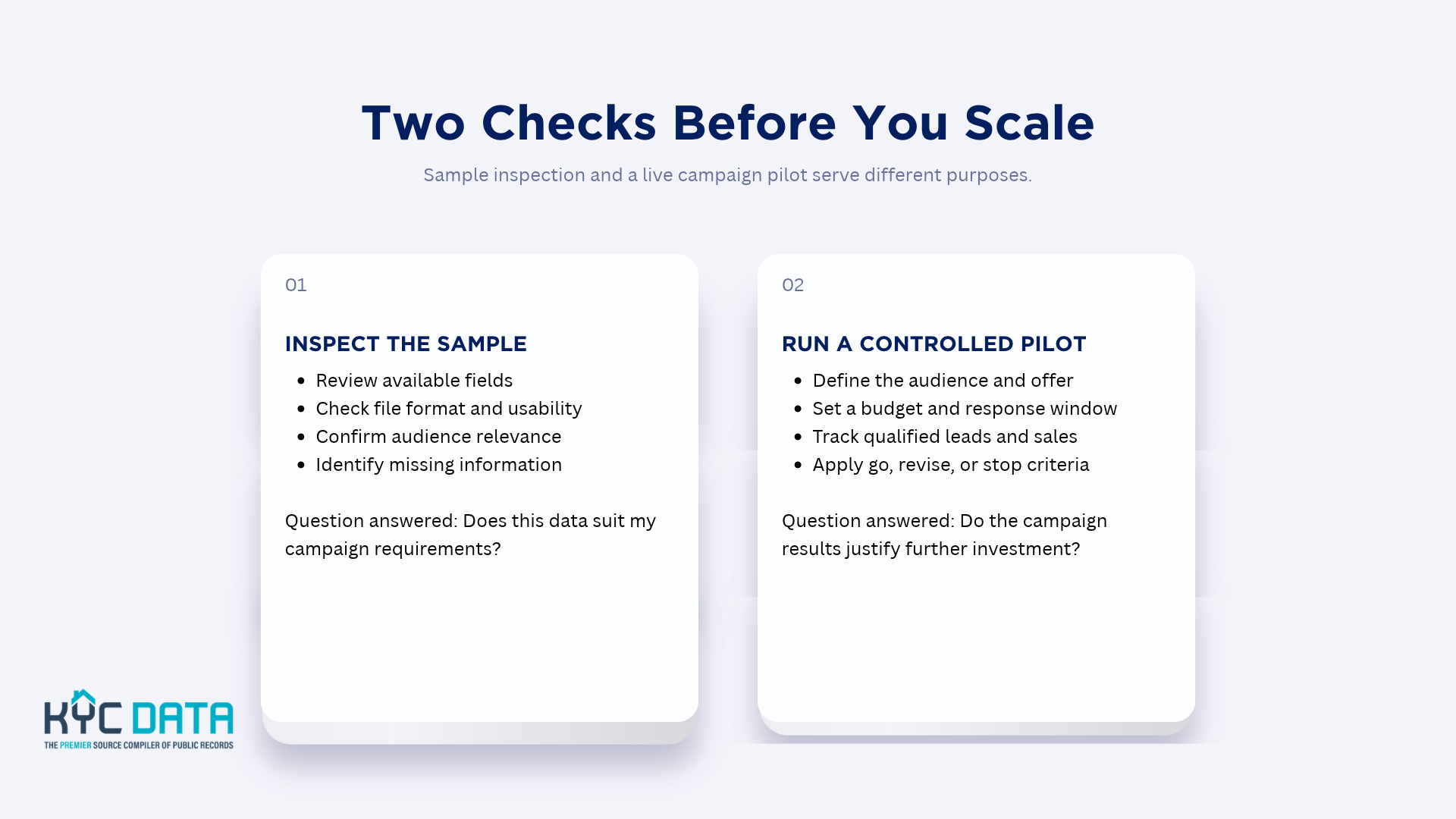
These checks answer different questions. A sample shows whether data suits your requirements. A campaign pilot tests whether the chosen audience and offer produce outcomes that justify further spending. Set decision criteria before launch so early responses do not drive the decision.
What can a free sample tell you?
A homeowner mailing list sample helps you check available fields, file format, and relevance to your intended audience. It cannot prove campaign response or establish the quality of every record in the full list.
Compare the sample fields with your campaign requirements. KYC Data’s new homeowner data page explains its data product and available information. Check whether the fields support your audience definition and whether your team can review and use the file correctly.
Check what the data excludes, too. KYC Data’s free-data form states that its consumer marketing data does not include phone numbers or email addresses. A recorded property purchase does not establish move-in date, owner occupancy, household needs, or purchase intent.
Treat sample inspection as a usability check. It can reveal formatting problems or unsuitable fields, but it cannot confirm full-list accuracy or predict sales.
What question should the pilot answer?
A direct mail pilot campaign should answer one defined business question. For example, can this audience generate qualified leads at a cost the business can support? Set the primary metric, audience, budget, response window, and go, revise, or stop criteria before launch.
Choose a metric that matches the decision. Qualified lead acquisition cost may suit a lead-generation campaign. Recorded sales may be more useful when the buying cycle and tracking process allow them to be measured.
Define a qualified lead before the campaign starts. Set a maximum spend and an end date for collecting responses. Do not stop after the first few enquiries or extend the test simply because results are disappointing.
There is no universal acceptable cost or minimum sample size for every business. Set criteria based on the offer, audience, margin, buying cycle, and question the test needs to answer. Write down these decisions so the results can be assessed consistently.
How do you make list comparisons fair?
Direct mail list testing is more useful when the lists are compared under similar conditions. Keep the offer, creative, service-area eligibility, format, and mailing date aligned. Otherwise, results may reflect differences in the campaign rather than the list source.
Different lists may contain different eligible populations. Document audience rules and check for overlap before mailing. Deduplicate records so the same household does not unintentionally receive multiple versions of the test.
Where practical, randomize eligible records between test groups. If you are comparing providers, use comparable eligibility criteria and document differences that cannot be removed. Even careful testing cannot guarantee a perfect causal comparison when populations differ.
Include data hygiene checks before releasing the file. Review formats, duplicates, address fields, and exclusions. Good test design depends on a suitable audience and a consistent process.
What tracking should be ready before mailing?
Prepare tracking before the first piece enters production. Assign a campaign ID, use a distinct response path where practical, and record lead sources consistently from enquiry through sale.
Depending on the advertiser’s setup, tracking may use a campaign-specific URL, response code, phone extension, or intake question. Keep the method consistent across test groups. Establish how a lead becomes qualified and how a resulting sale will be recorded.
Track enquiries, qualified leads, sales, spend, and returned mail separately. Returned mail is a delivery issue to investigate. A piece that is not returned is not confirmed as delivered or read by the intended recipient.
USPS guidance on tracking direct mail describes ways to connect mailings with responses. Attribution still depends on the tracking method and the records available.
KYC Data supplies consumer marketing data, not a mail execution or analytics platform. The advertiser is responsible for arranging mailing and measuring campaign outcomes.
What can a holdout group add?
A campaign holdout group can help estimate whether mailing generated additional outcomes. Randomly assign eligible people to a mail group or a no-mail group, then compare relevant outcomes over the same period.
Keep other marketing treatment as comparable as possible. If one group receives a separate promotion or different sales follow-up, the results may not isolate the effect of direct mail. Record any differences that could influence the comparison.
A holdout group answers a different question from comparing two list providers. It estimates the additional outcome associated with mailing relative to not mailing within the test design. A provider comparison examines how two eligible list populations perform under aligned campaign conditions.
Neither approach guarantees a definitive result from a small pilot. Assignment, audience overlap, tracking quality, other marketing activity, and the number of outcomes recorded can all affect interpretation. Decide in advance what the test can reasonably establish.
When is the evidence strong enough to scale?
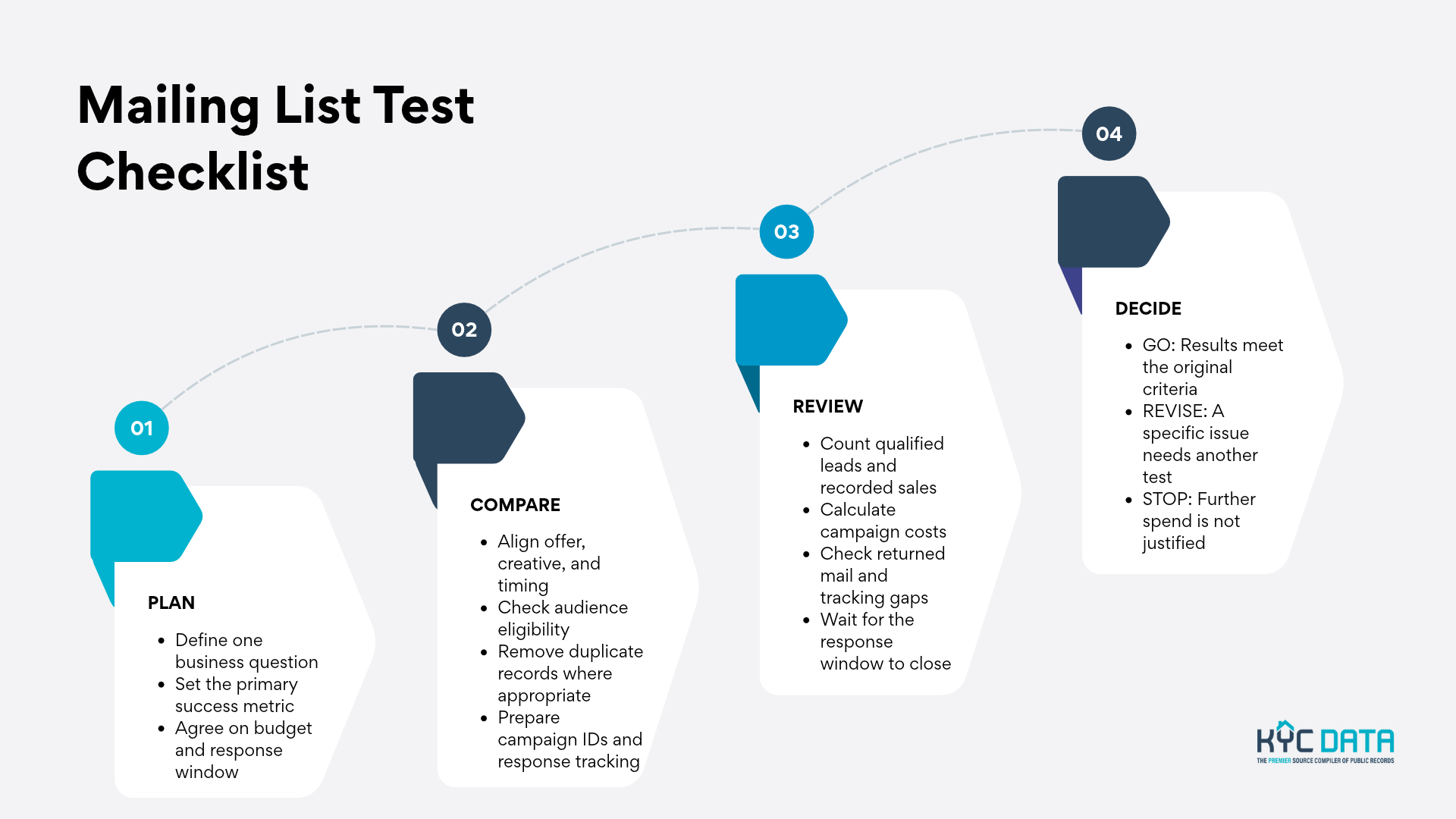
Scale only after the planned response window closes and the results have been checked against your original criteria. Review outcome counts, costs, lead quality, sales, returned mail, and tracking problems before deciding.
Small pilots produce uncertain estimates, especially when few qualified outcomes occur. Do not describe a small difference as statistically significant without an appropriate analysis. If the result is unclear, repeat the test or expand in stages under comparable conditions.
Use three practical decisions. Go means the results meet your predefined criteria. Revise means a specific issue, such as audience fit or tracking, needs further testing. Stop means the evidence does not justify additional spending under the current plan.
Do not scale based only on early responses or a high percentage from a very small group. Record what was tested, what changed, what was measured, and what remains uncertain. That makes future decisions more useful than a broad claim that a list performed well.
Conclusion
A controlled test separates list usability from campaign performance. Inspect the fields first, define one business question, align the test conditions, and prepare tracking before mailing. Set the budget, response window, and go, revise, or stop criteria in advance. Then review qualified outcomes and costs before expanding.
To begin, request a free data sample from KYC Data and check the available fields against your audience requirements. The form states that the data is intended for consumer direct marketing and does not include phone numbers or email addresses. Use the sample to plan an appropriate test, not as a promise of campaign results.