

Warranty deed data is public record information tied to a documented property ownership transfer. It can help direct mail marketers identify recent property buyers, understand when a property changed hands, and build targeted homeowner lists using available geographic and transaction criteria. A deed record may include information such as the buyer, property address, purchase date, recording date, and purchase price. It can also be compared with mortgage records to help identify potential cash purchases. The usefulness of the data depends on record freshness, classification, address quality, and data hygiene. KYC Data provides warranty deed records for marketers building property-based direct mail audiences.
What Is a Warranty Deed?
A warranty deed is a recorded legal document used to transfer ownership of real property from a seller to a buyer.
For marketers, the important point is that a warranty deed documents a property ownership transfer. The document is generally submitted to a county recording office or other local authority and becomes part of the public record.
Depending on the jurisdiction and available record, the deed may identify the buyer, seller, property address or legal property reference, purchase price, and relevant dates. The purchase date and recording date are not necessarily the same.
A warranty deed is also different from a mortgage record. A deed documents the property ownership transfer, while a mortgage record documents financing secured against the property. Understanding this distinction is important when building a marketing list.
What Information Is Included in Warranty Deed Data?
Warranty deed data typically contains property-transfer details available in the recorded public document, but the exact fields can vary by county and record.
Fields may include:
● Buyer name
● Seller name, when available
● Property address
● Purchase date
● Recording date
● Purchase price
● Property type or dwelling type, when available
● Mailing-related address fields
● Address-standardization or delivery-point fields used for mailing preparation
Seller information is not guaranteed on every record. A standalone deed also does not normally provide a mortgage amount or lender information. Those details generally come from mortgage records.
Phone numbers and email addresses are not standard deed fields. Warranty deed data is therefore better understood as property transfer data, not a complete consumer profile.
KYC Data collects public-record deed information rather than appending unrelated private consumer information. Available fields can vary based on the underlying record and the requested data product.
How Is Warranty Deed Data Collected?
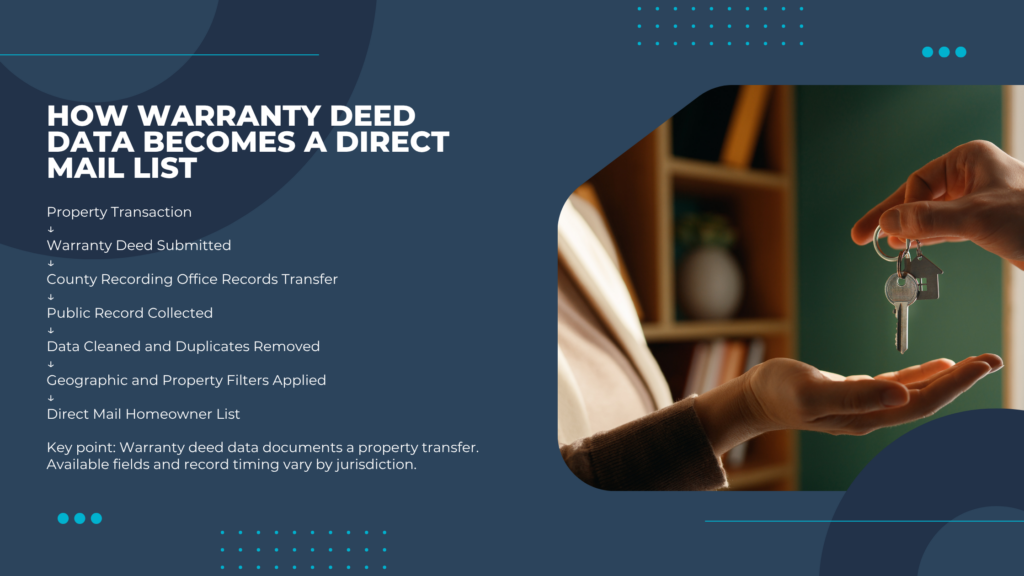
Warranty deed data is collected from public records made available by county or local recording offices.
The basic process is:
● A property transaction closes.
● The deed is submitted to the appropriate recording office.
● The county records the document.
● The recorded information becomes available through the public-record process. ● The record is collected and reviewed.
● Data-cleaning rules are applied.
● Usable records are added to the appropriate database.
● Records become available for list selection and delivery.
County recording speed varies. Some jurisdictions make records available relatively quickly, while others may have processing delays caused by local procedures, technology, staffing, or recording volume.
This means fresh data should be understood in relation to when a record becomes available. KYC Data can collect and process available public records, but it does not control how quickly an individual county records a transaction.
How Does Warranty Deed Data Help Identify New Homeowners?
A recorded deed provides evidence that ownership of a property has changed, making it an important source of recent homeowner data.
The deed shows a transfer from seller to buyer. The purchase date or recording date can then help establish how recent the transaction is. The buyer and property address can form the basis of a new homeowner mailing list or direct mail homeowner list.
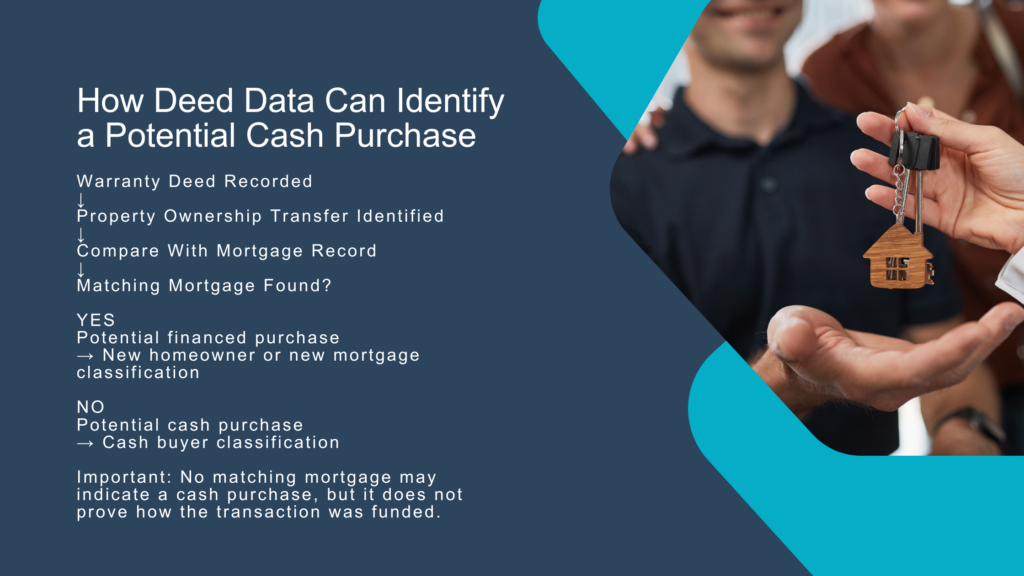
The deed can also be compared with mortgage information to help classify the transaction. When a deed corresponds with a mortgage record, the transaction may be classified as a new mortgaged purchase. When a deed has no corresponding mortgage record, it may indicate a cash purchase.
By contrast, a mortgage record without a related recent deed may represent refinancing rather than a new property purchase.
These classifications are not absolute. Public records can vary, and a later mortgage or other financing event may be recorded separately. KYC Data uses the relationship between deed and mortgage records as part of its broader new homeowner data process.
How Can Warranty Deed Data Identify Cash Buyers?
A warranty deed without a corresponding mortgage record may indicate that the property was purchased without a recorded purchase mortgage.
The deed establishes that the property changed ownership. A comparison with mortgage records can then show whether financing was recorded in connection with the transfer. When no matching mortgage is found, the record may be classified as a potential cash purchase.
This classification should not be treated as proof of how every part of the transaction was funded. A later mortgage or other financing arrangement may occur separately.
For marketers, cash home purchase data can provide another way to segment recent property buyers. A cash buyer is still a recent homeowner and may be relevant to campaigns for insurance, home services, security, landscaping, repairs, improvements, or other property-related services.
Cash buyer data should identify a property event, not be used to assume a buyer’s income, wealth, or purchasing power.
How Is Warranty Deed Data Used in Direct Mail Marketing?
Direct mail marketers use warranty deed data to build audiences based on recent property ownership changes.
A typical workflow starts with selecting a geographic market and purchase or recording window. The marketer can then apply available property criteria, review buyer and property fields, and prepare the resulting file for mailing.
A practical workflow may look like this:
● Select the target state, county, scf or ZIP Code, or other available geographic criteria.
● Set the desired purchase or recording period.
● Apply relevant property or transaction filters.
● Review available buyer and property fields.
● Remove duplicates and apply suppression requirements.
● Standardize addresses and prepare the file for the mailing house.
● Send a relevant offer to the selected audience.
A recent property transfer creates a defined homeowner event. Businesses can use that event to time offers related to moving, property setup, insurance, repairs, improvements, or local services.
KYC Data focuses on direct mail data and can provide output structured around mailing requirements. This allows marketers to select and organize records for use with their own mailing house or campaign process.
Which Businesses Can Use Warranty Deed Data?
Warranty deed data can be useful for businesses whose offers relate to property ownership or the period immediately after a purchase.
Insurance companies may use recent property transfer data to identify new homeowners for homeowners insurance, mortgage protection insurance, or related policy services.
Home service businesses can use recent homeowner data to reach buyers with offers for pest control, HVAC, plumbing, roofing, flooring, landscaping, security, solar, and remodeling.
Marketing agencies may use deed data to build targeted audiences for clients across multiple geographic markets.
Direct mail companies and data resellers may incorporate deed records into recurring new homeowner mailing list fulfillment.
Financial service providers may use recent property purchases for appropriate homeowner-focused campaigns, although a deed record does not establish that a person qualifies for a particular financial product.
The common factor is the property event. Businesses are not simply targeting people because they own homes. They are targeting a recorded ownership change that may make the audience relevant to a specific offer.
What Filters Can Marketers Use?
Useful filters help marketers narrow warranty deed data to households that fit a campaign instead of mailing every recent buyer.
Depending on the available records and product, relevant filters may include:
● State
● County
● ZIP Code
● SCF region
● Purchase date
● Recording date
● Property type
● Dwelling type
● Purchase price
● Deed-only status, when available
● Other available property criteria
Not every field is available in every county. The available filter set depends on the source record, jurisdiction, and data product.
Marketers should therefore confirm the actual fields and filters available before ordering a warranty deed mailing list. A provider should be able to explain which criteria can be used and which cannot.
Why Does Data Hygiene Matter for Warranty Deed Lists?
Not every recorded deed is equally useful for direct mail, so deed data must be reviewed and cleaned before it becomes a marketable list.
Data hygiene can address duplicate records, formatting inconsistencies, nonmarketable deed types, family or spousal transfers, incomplete addresses, records outside the selected market, and transactions outside the desired campaign window.
Certain deed types or transfers may not represent a conventional market transaction. Removing records that are not useful for marketing can help prevent a campaign from treating every recorded ownership change as a typical home purchase.
Address standardization is also important for direct mail production. Duplicate removal can reduce repeated mailings, while suppression helps marketers avoid sending mail to records that should be excluded.
KYC Data applies data-cleaning processes to help organise marketable public-record information. The purpose is to give marketers a cleaner starting point, not to guarantee campaign performance.
Need a closer look at the data? KYC Data can provide a free data sample so marketers can review available fields and record formats before deciding which list fits their campaign.
What Warranty Deed Data Does Not Tell You
Warranty deed data identifies a property event. It does not provide a complete consumer profile. Standalone deed records do not automatically provide:
● Phone numbers
● Email addresses
● Household income
● Owner-occupancy status
● Available cash
● Future buying intent
● Guaranteed seller information
● Mortgage amounts
● Lender information
A deed also does not prove that a buyer has a particular level of wealth or that the buyer intends to make another purchase.
KYC Data focuses on public-record deed information rather than appending unrelated private consumer information. This keeps the product focused on property-transfer data and its direct mail applications.
The strength of the data is the recorded ownership event. Marketers should combine that signal with appropriate geographic, property, timing, and campaign criteria rather than treating the deed as a complete picture of the household.
How Should Marketers Evaluate a Warranty Deed Data Provider? A useful provider should be able to explain both the value and the limitations of its records.
Before ordering property deed data, ask:
● How frequently are deed records collected?
● How quickly are records added after county availability?
● Are deeds matched against mortgage records?
● Can deed-only transactions be identified?
● Which deed types are excluded?
● How are duplicates handled?
● Are addresses standardized?
● Is seller information available, and is it guaranteed?
● Which geographic filters are available?
● Which property filters are available?
● Can output columns be customized?
● Can the file be formatted for a mailing house?
● Are suppression options available?
● Is a data sample available before purchase?
● Does the provider explain what the data does not include?
KYC Data focuses on fresh public-record data, verification, data hygiene, customizable output, and direct mail applications. Buyers can review a free sample and speak with a data expert about the appropriate record type.
When Should a Business Use Warranty Deed Data Instead of a General Homeowner List?
Warranty deed data is most useful when a campaign depends on a recent ownership transfer rather than simply reaching people who own homes.
Use deed data when the campaign targets recent buyers, timing after the purchase matters, or the offer relates to moving, property setup, insurance, repairs, improvements, or local services. It can also be useful when a marketer wants to distinguish newer owners from the broader homeowner population.
A general homeowner list may be more appropriate when the campaign does not depend on a recent purchase or when the audience is based on broader homeowner characteristics.
The right choice depends on the event behind the campaign. Warranty deed data provides a specific property-transfer signal, while a general homeowner audience serves a broader purpose.
Questions to Ask Before Ordering Warranty Deed Data Before ordering a warranty deed mailing list, ask:
● How recent are the records?
● Which counties and markets are covered?
● Which fields are included?
● Is seller information available?
● Can deed-only purchases be separated?
● Which deed types are filtered out?
● How are duplicates and address issues handled?
● Can I filter by purchase date, geography, price, or property type?
● Can the export be customized for my mailing provider?
● Can I review a free sample before ordering?
These questions can help a data buyer understand whether the records fit the campaign before placing an order.
Is Warranty Deed Data Public Information?
Warranty deed information is generally taken from public property records maintained by county or local recording offices. The exact information available and the speed at which it becomes accessible vary by jurisdiction.
Does Warranty Deed Data Include Mortgage Information?
Not usually by itself. Mortgage amount and lender information generally come from a separate mortgage record. A deed can be matched with mortgage data to help classify the transaction.
Can Warranty Deed Data Identify Cash Buyers?
A deed without a related mortgage record may indicate a cash purchase. This should be treated as a data classification rather than proof of every detail of the transaction.
Does Warranty Deed Data Include Phone Numbers or Email Addresses?
Standard deed records do not normally include phone numbers or email addresses. KYC Data focuses on public-record direct mail data rather than promising unrelated digital contact information.
What Businesses Use Warranty Deed Mailing Lists?
Insurance companies, home service businesses, marketing agencies, contractors, data resellers, and other direct mail marketers may use deed data to reach recent property buyers.
How Quickly Is Warranty Deed Data Available?
Availability depends on when the county records and releases the document. Some records become available quickly, while others may be delayed by local processing practices.
Conclusion
Warranty deed data identifies recorded property ownership transfers and can help marketers reach recent homeowners and potential cash buyers. Its usefulness depends on accurate classification, current records, clean addresses, appropriate filters, and a clear understanding of what the record contains.
For direct mail marketers, the deed is best treated as a property-event signal rather than a complete consumer profile. When the campaign depends on reaching recent buyers, properly prepared warranty deed data can provide a focused starting point for audience selection.
Build a More Focused Direct Mail List With KYC Data
KYC Data provides fresh warranty deed, new homeowner, mortgage, and equity records for direct mail campaigns. Review available geographic and property filters, customise the output for your mailing process, and request a free data sample before placing an order.
Contact KYC Data to speak with a data expert and determine which record type fits your campaign.