
Every new homeowner acquisition campaign needs a clear answer to one question: when to stop mailing new homeowners. Stop when a recipient converts or asks to be removed. Pause records that need investigation, including returned mail. An inquiry may need a different follow-up instead of another generic offer. Set a planned sequence limit and review campaign economics rather than applying one mailing count to every audience.
These decisions should be documented before the first file is released. A rule that exists only in someone’s inbox can be missed when staff, agencies, or mailing schedules change. Clear direct mail exit rules help campaign managers decide what happens to each record, who owns the decision, and how it is reflected in the next mailing file. They also prevent a finished sequence from quietly restarting when fresh data arrives.
What is a direct mail exit rule?
A direct mail exit rule is a documented event that triggers a specific action for a record in an acquisition campaign. The action might be to stop future acquisition mail, pause mail while a problem is checked, or change the message because the recipient has started a conversation.
These are different decisions. A removal request means suppress the record from future mailings covered by that request. A returned piece may require investigation before another mailing is considered. An inquiry may need a staff member to respond, rather than another general acquisition offer.
This is an operational layer within multi-touch direct mail campaigns. The goal is not to prescribe a universal frequency. It is to define what should happen as a recipient’s status changes, and to assign responsibility for applying that rule.
Which events should stop acquisition mail?
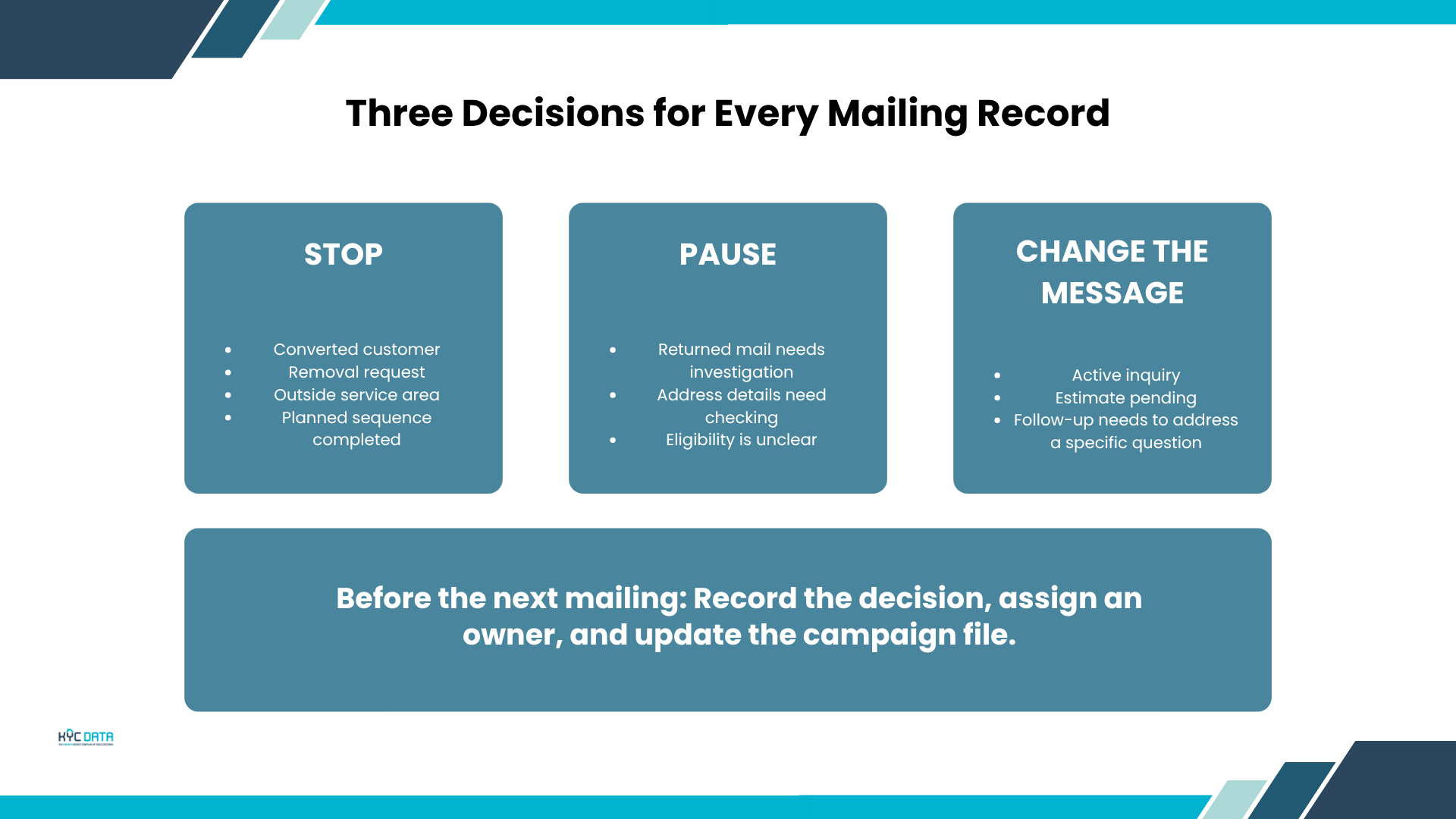
Stop the planned acquisition sequence when a clear trigger makes further acquisition mail inappropriate. Record the trigger, action, and responsible owner so the decision reaches the next mailing file.
| Trigger | Action | Owner |
|---|---|---|
| Converted customer | Stop acquisition sequence; review separately for customer communications | Sales or account owner |
| Removal request | Add to applicable suppression list and confirm before release | List or campaign manager |
| Outside service area | Exclude from this campaign | Campaign manager |
| Planned sequence completed | Mark sequence complete; do not restart automatically | Campaign manager |
A conversion is not permission for unlimited customer marketing. Any later customer communications should follow the business’s own permissions, preferences, and policies. Similarly, a removal request should not disappear simply because a campaign has ended or a new list has been purchased. Preserve suppression records according to the advertiser’s documented process.
The owner named in the table must be able to update the campaign status or notify the person who maintains the file. A trigger without a responsible owner is only a note, not an effective exit rule.
When should you pause or change the message?
Pause a record when its status needs checking; change the message when the person’s next step is different from the original acquisition journey.
An active inquiry should be routed to a named person or team with a clear response deadline. If an estimate is pending, check whether the next communication should answer a question, confirm a visit, or wait for the customer’s decision. Sending another generic offer may ignore the conversation already underway.
Returned mail also deserves review before another piece is sent. Check the address and the reason for return if available. Do not assume every returned piece proves that a person has moved; the cause may be an address error or another delivery issue.
Set a pause status, owner, and review date. That prevents a temporary hold from becoming an indefinite limbo or disappearing unnoticed. Resume only when the issue is resolved and the record remains eligible for the campaign.
How many mailings are enough?
There is no single mailing count that suits every offer, audience, buying cycle, or business budget. Set an initial cap, a response window, and a cost ceiling before launch, then review evidence before extending the sequence.
The initial cap defines the maximum planned touches before a record is marked complete. The response window allows time for replies or conversions to be recorded. The cost ceiling sets a limit for production and postage against the campaign’s purpose. These are planning controls, not industry benchmarks.
Choose them based on the offer, the likely decision process, available budget, and the value of a potential customer. A service with a long consideration period may need a different plan from a time-sensitive offer. Do not extend a sequence simply because the next mailing date is on the calendar.
Track responses and conversions using a consistent method. USPS guidance discusses approaches such as response codes and match-back analysis, which can help connect outcomes to a mailing, though attribution has limitations. Use what the campaign actually shows before deciding whether to continue, revise, or stop.
How do you keep stopped records out of the next file?
Reconcile campaign status against the advertiser’s suppression and campaign records before every mailing file is released. KYC Data supplies data for consumer direct marketing; it is not the advertiser’s mail execution or analytics platform, and you should not assume it automatically synchronizes CRM statuses or suppression records.
Maintain a controlled suppression list with the record identifier, reason code, decision date, and responsible owner. Keep other status fields for pauses, completed sequences, inquiries, and conversions. Match those records against the proposed mailing file, resolve exceptions, and document who approved the final version.
Allow enough time for this check before print and mail production cutoffs. A change recorded after a file has gone to production may not prevent that piece from being mailed. Set a clear handoff deadline and escalation path for late updates.
This process supports data hygiene for direct mail. Clean source data matters, but so does maintaining the campaign decisions that determine whether a record should be included. A new list does not replace the advertiser’s responsibility to apply its own suppression rules.

What should you review before restarting a campaign?
Before restarting, confirm that the original reason for stopping or pausing has been resolved and that the recipient is still eligible. Check previous removal requests first. Do not automatically re-enroll suppressed recipients because new homeowner data arrives or a fresh campaign is created.
A purchase record does not establish a move-in date, owner occupancy, household needs, or purchase intent. New records can identify potential audiences, but they do not erase prior campaign history. Keep source data and campaign status separate, then reconcile them before a record is considered for a new sequence.
A planned new test should have a defined audience, offer, cap, measurement approach, and stop conditions. That is different from continuing a sequence that reached its limit or failed to justify further spend. Document why the test is being launched and what evidence will lead to another decision.
Review delivery issues, inquiries, conversions, costs, and removal requests together where the information is available. No single metric explains every outcome. Use the review to decide whether to restart, change the offer, narrow eligibility, or leave the record stopped.
Conclusion
Write exit rules before launching a new homeowner campaign, then assign an owner to each decision. Stop acquisition mail after conversion or a removal request, pause records that need investigation, and route active inquiries to relevant follow-up. Set a sequence cap and response window, then reconcile campaign status and suppression records before every release. Fresh records should never silently restart a completed sequence.
Before planning your next campaign, request a free data sample from KYC Data and inspect the available fields. The form states that the data is intended for consumer direct marketing and does not include phone numbers or email addresses. Check the inputs first, then build campaign rules around the data and processes you actually have.