
How to Choose a Data Provider for Direct Mail Campaigns
Choosing the right data provider for direct mail campaigns is not as simple as it looks. Many providers offer similar products on the surface—large lists, broad coverage, and fast quotes. But once a campaign goes live, performance often reveals major differences in data quality.
The risk of choosing the wrong provider is real. Poor data leads to wasted mail, lower response rates, and inconsistent results. In acquisition campaigns, the quality of the mailing list directly affects outcomes before creative or offers even come into play.
This article explains what actually matters when selecting a provider. It breaks down the key factors—freshness, accuracy, hygiene, and delivery speed—so you can make a more informed decision and avoid common mistakes.
Why Your Data Provider Matters More Than You Think
Your direct mail data provider is the foundation of your campaign.
Every result—good or bad—starts with the data. If the audience is wrong, outdated, or incomplete, the campaign is limited before it reaches the mailbox.
Data quality affects:
● Response rates
● Return on investment (ROI)
● Wasted spend
For example, direct mail response rates typically range between 2% and 5%, depending on targeting and list quality. A weak list can push performance below that range, regardless of creative quality.
In simple terms:
Better data creates better starting conditions for campaign performance.
The Problem With Most Data Providers
Not all providers operate at the same standard. Many common issues in the industry affect data for direct mail marketing:
Outdated lists
Records updated monthly or less frequently lose relevance over time
Bulk, recycled data
Some providers resell the same lists repeatedly without meaningful updates
Lack of verification
Records may not be tied to confirmed property or ownership changes
Slow delivery
Delays reduce the ability to act during key timing windows
These problems are not always obvious when reviewing a list. They usually appear later in campaign performance.
For time-sensitive audiences like new homeowner data, delays can reduce effectiveness quickly. The first 90 days after a move are often the most active decision period. Late data misses that window.
What to Look for in a Direct Mail Data Provider
Data Freshness
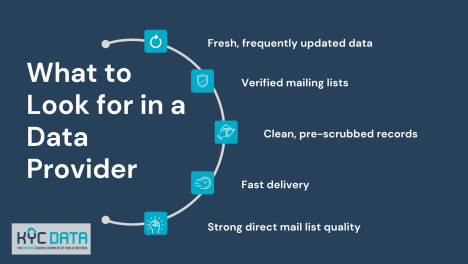
Fresh data is one of the most important factors in direct mail list quality.
Look for:
● Frequently updated records (daily or near-daily)
● Recently sourced new homeowner data or new mover data
● Minimal lag between event and availability
Fresh data aligns with real-world timing. It allows campaigns to reach households when they are most likely to respond.
Data Accuracy
Accuracy determines whether your message reaches the right person.
Strong verified mailing lists include:
● Correct names and addresses
● Confirmed property or ownership data
● Reduced undeliverable mail
Inaccurate data leads to:
● Missed delivery
● Lower response rates
● Higher costs per acquisition
● Data Hygiene
Data hygiene is often overlooked but has a direct impact on efficiency. Clean mailing lists should include:
● Duplicate removal
● Standardized formatting
● Complete and consistent records
Even a small issue can scale:
A 100,000-piece campaign with 5% duplicates results in 5,000 wasted mailers Pre-scrubbed, clean mailing lists reduce internal work and improve campaign execution.
Delivery Speed
Speed affects timing, and timing affects performance.
Look for providers that offer:
● Fast turnaround times
● Reliable delivery schedules
● Ability to support time-sensitive campaigns
For example:
A delay of even 1–2 weeks in data delivery can reduce relevance in new mover campaigns Faster delivery helps campaigns reach households closer to key decision moments.
How Data Quality Impacts Campaign Performance
Data quality is not just a technical detail. It directly affects outcomes.
Key performance areas include:
● Response rates
● Better targeting increases the likelihood of engagement
● Cost per acquisition (CPA)
● Cleaner data reduces wasted impressions
● Conversion rates
● Relevant audiences improve conversion potential
Comparison:
| Low-Quality Data High-Quality Data |
| Outdated records Fresh records |
| Inconsistent targeting Precise targeting |
| Higher waste More efficient spend |
| Lower response rates Stronger engagement |
Real-world example:
A home services campaign using older lists saw low engagement
After switching to fresher, verified data, targeting improved and results became more consistent The change came from better data, not changes in creative.
Questions to Ask Before Choosing a Provider
Before selecting a mailing list provider, ask clear and direct questions:
● How often is the data updated?
● Is the data verified or compiled?
● How fast is delivery after ordering?
● Is the data pre-scrubbed and cleaned?
● What fields are included in the records?
These questions help reveal differences that are not obvious in sales materials.
Red Flags to Avoid
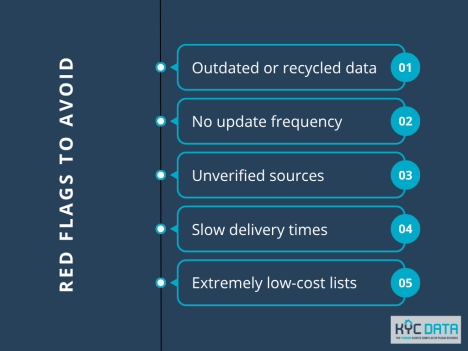
Some warning signs indicate lower-quality providers:
● Extremely low-cost lists
● Often reflect outdated or recycled data
● No transparency on data sources
● Lack of clarity reduces trust
● No stated update frequency
● Suggests inconsistent freshness
● Delayed delivery timelines
● Limits campaign timing
If a provider cannot clearly explain how their data is sourced, updated, and cleaned, it becomes harder to evaluate performance risk.
Why the Right Data Provider Gives You a Competitive Advantage
Choosing the right data provider for direct mail campaigns creates a measurable advantage.
Benefits include:
● Better timing alignment
● Higher response rates
● More efficient campaigns
● Reduced wasted spend
In competitive industries like insurance, solar, and home services, reaching the right household first can influence outcomes.
Timing and data quality together create stronger campaign positioning.
Why Marketers Choose KYC Data
KYC Data is built for performance-focused direct mail campaigns.
Key characteristics include:
Fresh, frequently updated data
New homeowner and mortgage records are added continuously to support timing-sensitive campaigns
Verified records
Data is based on confirmed property and transaction sources, not recycled bulk lists
Pre-scrubbed data
Lists are cleaned and formatted for immediate use, reducing internal workload
Fast delivery
Designed to support quick campaign launches and tighter timelines
Built for agencies and direct mail performance
Structured to align with real campaign workflows and targeting needs
The focus is not just on providing data, but on improving the starting point of every campaign.
Common Mistakes to Avoid
Many marketers make similar assumptions when choosing a provider:
● “All data providers are the same”
● “Cheaper lists perform just as well”
● “Timing does not matter”
● “More data is better than better data”
In practice, these assumptions often lead to lower performance and higher waste.
Conclusion
Choosing the right data provider for direct mail campaigns is a critical decision. The quality, freshness, and delivery speed of your data directly influence campaign results.
Better data improves targeting, reduces waste, and supports more consistent performance. Poor data does the opposite, often without being immediately obvious.
By focusing on freshness, verification, hygiene, and speed, marketers can make more informed decisions and avoid common pitfalls.
Contact KYC Data for Your Direct Mail Campaigns Today
If you want to evaluate data quality before your next campaign, request a sample from KYC Data, get a quote, or speak with a data expert about your targeting strategy.