
Marketing to homeowners works best when the offer fits a plausible ownership need, not just time since purchase. Use purchase records to introduce helpful services, confirmed customer history to support maintenance offers, and relevant property or equity signals to frame optional projects. Treat every stage as a hypothesis, not proof of intent.
The challenge is choosing a relevant offer without claiming more than the data shows. An ownership stage is a provisional planning category, not a verified field or description of a household. This is a practical starting point for homeowner marketing decisions today.
- Ownership signals suggest possibilities, not confirmed needs.
- Offer commitment should match evidence strength.
- Homeowners can skip or revisit stages.
- Clean records support relevance, not guaranteed results.
What should an ownership stage tell you about an offer?
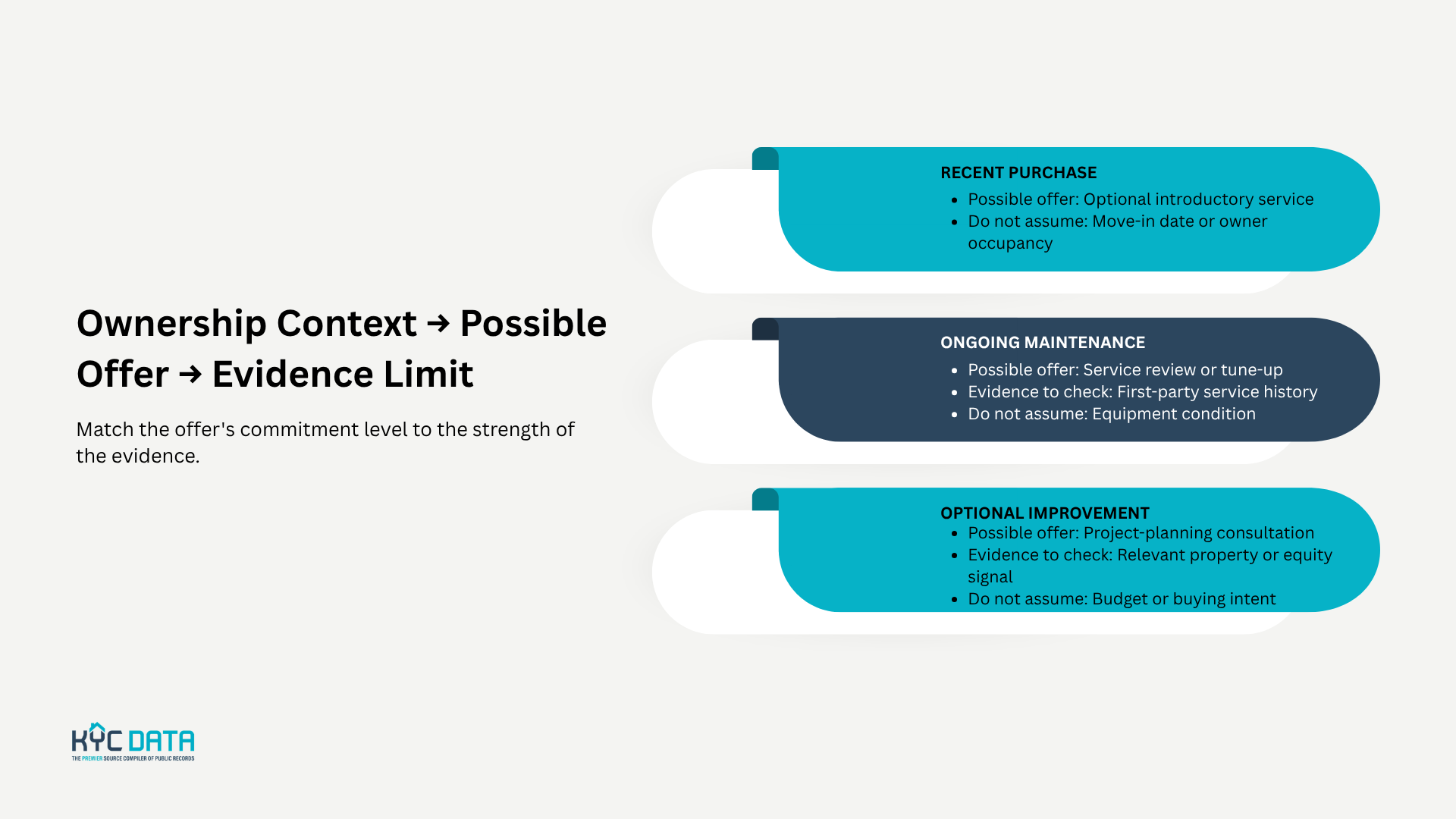
An ownership stage should change how relevant an offer feels or how much commitment it asks from the recipient. Commitment level means the time, cost, or decision effort required. Homeowner segmentation connects a recorded signal to a possible need, then to a suitable offer and its evidence limit.
Stages overlap. They are not a fixed purchase calendar, and a homeowner may revisit earlier decisions. A deed recording can support an introductory offer, not a claim of urgent repairs. KYC Data supplies record-based inputs, not verified household intentions or needs. This distinction should guide each offer choice.
Which offers fit a recent home purchase?
A recent purchase can support an introductory offer that is easy to consider without implying a known problem. A pest-control business could offer an optional inspection with its scope and price explained. It should not claim the property has an infestation.
KYC Data’s new homeowner data is based on recorded purchase information. That signal can inform marketing to new homeowners and new homeowner marketing, but it is not a move-in date. A homeowner mailing list does not establish occupancy or an immediate service need. Keep direct mail offers for homeowners optional and avoid savings claims or a mandated response window.
Which offers fit ongoing home maintenance?
Maintenance offers should be invitations, not diagnoses based on how long someone has owned a property. A business can use first-party service history, information gathered through its own customer relationship, to support a reminder. For acquisition audiences without that history, keep the offer general and optional.
For example, an HVAC company could invite a homeowner to review the scope and price of a tune-up. A deed record cannot reveal equipment age, condition, or whether service was missed. Home maintenance marketing should not infer a repair need. Clean records do not show system condition, equipment age, or prior maintenance history either.
Which offers fit larger home improvement projects?
Home improvement marketing should invite exploration, not assume readiness or ability to buy. Home equity generally means a property’s value minus the debt secured by it; any data-derived estimate depends on its source and timing. It is not proof of available cash, disposable income, or financing eligibility.
The CFPB defines home equity in relation to a home’s value and existing mortgage debt.
A remodeler might offer a project-planning consultation about project options. Homeowner equity data may help frame an optional conversation, but it cannot establish budget, intent, or willingness to borrow. For a deeper discussion, see marketing to high-equity homeowners.
How do you choose an offer when the stage is uncertain?
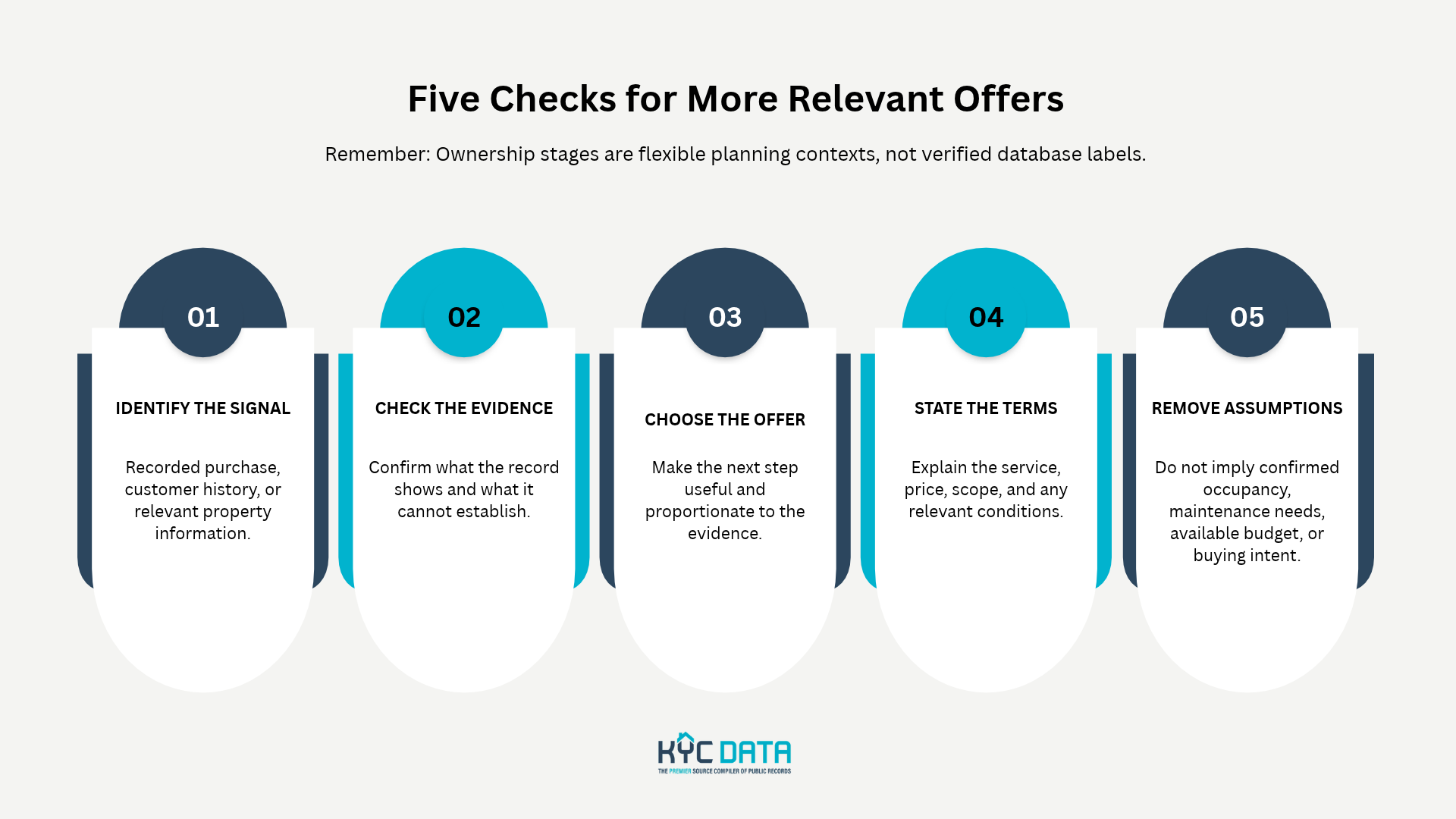
Choose the least assumptive offer that still gives the recipient a useful next step. To understand how to match direct mail offers to homeowner needs, start with the actual fields available, check their freshness and cleanliness, select a plausible offer, and state its terms.
A recorded fact is not the same as a marketing hypothesis: the first describes what a record shows; the second suggests what might be relevant.
Confirm that the intended use is permitted. Do not assume separate data sources can be combined freely.
Illustrative offer-selection framework
| Ownership context | Evidence to check | Illustrative offer | What not to assume |
|---|---|---|---|
| Recent purchase | Recorded deed transaction | Optional introductory service | Move-in or owner occupancy |
| Ongoing maintenance | Confirmed first-party service history, if available | Service review or tune-up | Equipment condition |
| Optional improvement | Relevant property or equity signal, if available | Project planning consultation | Budget or intent |
First-party service history is not a KYC-supplied field. Ownership stages are flexible contexts, not database labels. Avoid recycling one discount for every audience or presenting inferred needs as facts. These are useful principles for homeowner segmentation, not a fixed lifecycle model. Data hygiene supports record cleanliness, but clean data alone does not guarantee a relevant offer or campaign result.
What else should marketers know before choosing a homeowner offer?
Channel, occupancy, and financial uncertainty limit what an offer can responsibly claim. Match all messages to available information and keep qualifications near all claims made. The FTC says advertising claims should be truthful and supported by evidence.
Does KYC Data’s New Homeowner Data include phone numbers or email addresses?
No. KYC Data’s New Homeowner Data does not include phone numbers or email addresses in this product. Keep examples focused on mail; do not assume enrichment is included. The explanation of why phone and email are not included provides further context.
Does a deed record confirm that the buyer lives at the property?
No. A recorded transaction does not verify owner occupancy or the actual move-in date at that address. Do not welcome someone home as though residence were confirmed. The record indicates a transaction, not occupancy or residence.
Can an equity signal qualify someone for financing?
No. An equity signal alone establishes neither willingness to borrow nor credit eligibility. Financial-product advertising needs compliance review. An estimated property figure is not a lending decision or a credit promise.
How can you put stage-based marketing to homeowners into practice?
Marketing to homeowners should begin with the evidence, then match the offer’s commitment level to what that evidence can reasonably support. Use purchase records for introductory services, customer history for maintenance reminders, and property or equity signals for project discussions. Keep assumptions out of the message.
Review the available fields before choosing an offer. Remove claims about occupancy, need, or budget that the data cannot establish. To assess whether KYC Data’s records fit your intended audience, request a free data sample and discuss the available fields with a data expert. The sample lets you inspect inputs, not guarantee campaign results.